
QUANTIFIED VALUE
The complete guide to welding gas savings: reclaim the ~25% of shielding gas wasted every year
SUXIN Academy · ~5 min read
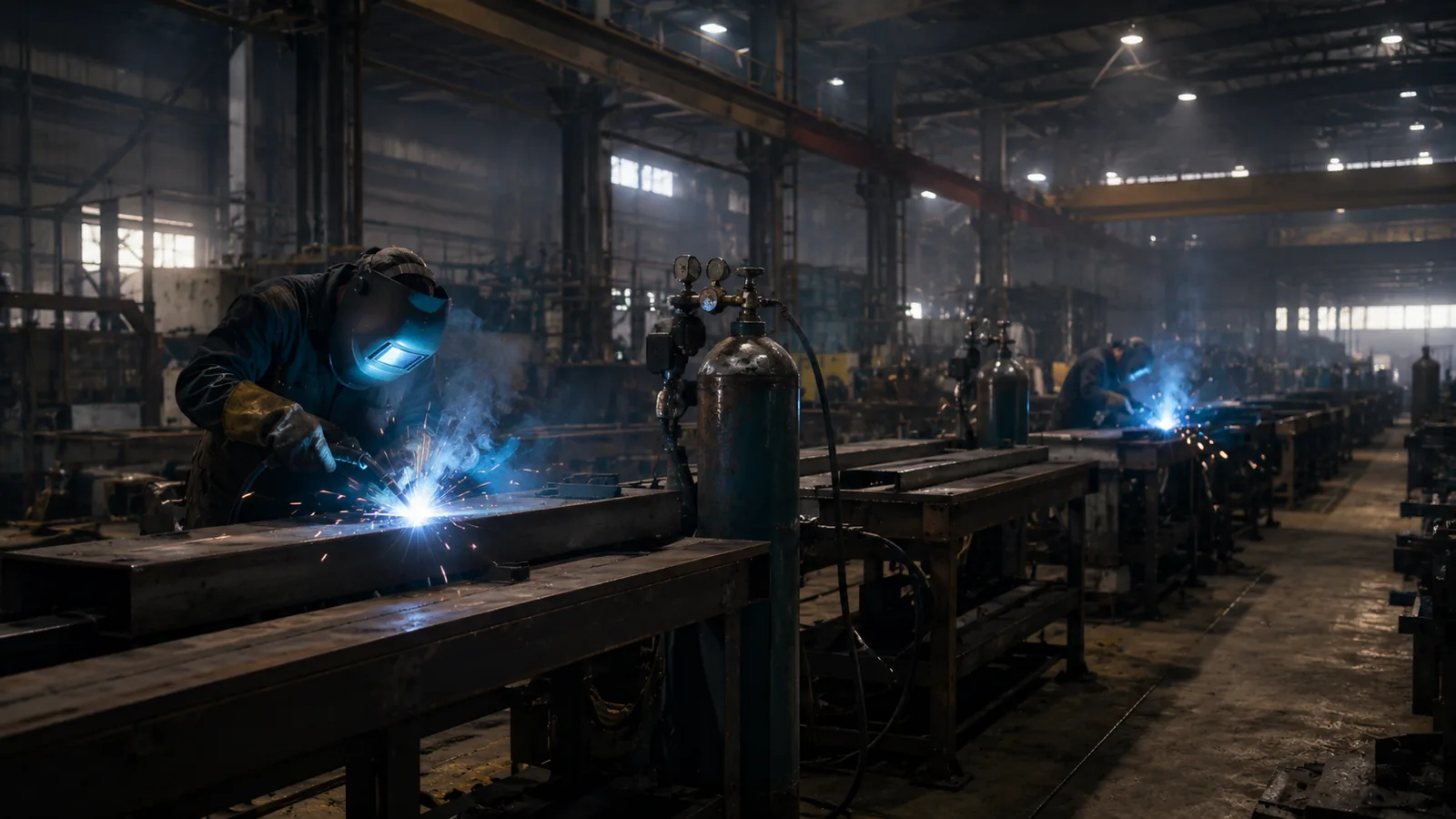
Most plants track wire and power, but few track shielding gas. On a typical MIG/TIG line, about a quarter of the shielding gas never reaches the weld — it leaks away as over-supply, flow drift, post-weld spillover and pipe leakage. It shows up on no work sheet, yet quietly inflates welding cost.
Welding gas saving does not mean cutting gas at the expense of weld quality — it means eliminating “ineffective supply”, reclaiming only the wasted portion. Waste comes from four places: chronically high metering and flow (≈10% and 5%), the over-surge at arc start (≈5%), continuous spillover after arc off (≈3%) and minor pipe leaks (≈2%) — about a quarter in total.
These four leaks persist because of how gas is supplied: a mechanical regulator holds pressure passively, blind to the welding process; operators set flow by experience and tend to over-set it “to be safe,” and cannot respond to transients like arc start and stop. Simply turning the flow down, or swapping in a “gas-saving valve,” treats the symptom, not the cause — too low risks under-protection and porosity; too high returns to waste.
To truly reclaim this gas, supply must track the welding process in real time: high-precision sensing reads the arc-start, arc-on and arc-off states, and the controller then runs an active closed loop, supplying gas on demand — suppressing arc-start overshoot, stabilizing flow, stopping at arc-off, and flagging leaks in time. What is recovered is wasted gas, not the gas the weld needs.
The approach is proven on real lines: BMW (Yancheng) saves ~15% on costly high-purity argon; Honda (Suzhou) 20%+ on mixed gas and CO₂; and across many China sites with signed verification, the median saving is ~30%, with no porosity in the welds. Annual savings = saving rate × annual gas volume, and the rate varies with management maturity — 30–50% on loosely managed lines, 15–20% on already-refined benchmark lines. Beyond the direct savings, less shielding gas also means lower carbon emissions.
SUXIN focuses on smart welding, with years of work on gas saving, 70+ invention patents, and deployments proven on leading lines such as BMW and Honda. To reclaim that wasted quarter, start by estimating your line’s annual savings with the gas-saving calculator.
Continue reading · Quantified Value
← Back to「Quantified Value」