
QUANTIFIED VALUE
The utilization question: why 100 welders often deliver only half their capacity
SUXIN Academy · ~5 min read
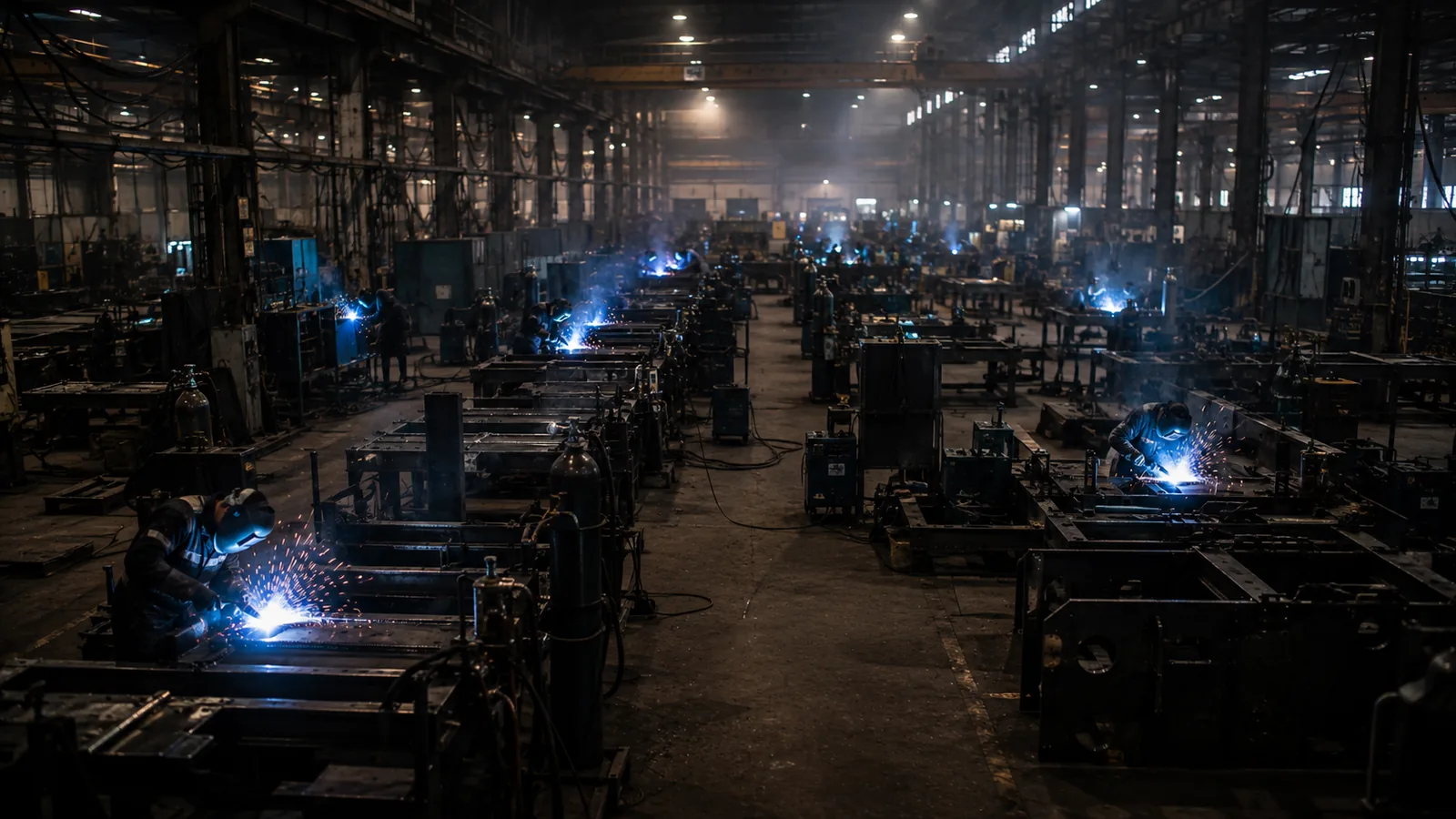
A powered-on welder is not the same as one that is welding. Under piece-rate pay, output largely depends on the welder’s own initiative; once management lapses, 100 welders often deliver only about half of their real capacity. Managers tend to answer a capacity shortfall by buying more equipment, when the true bottleneck usually lies in utilization.
The core of the problem is that “utilization is invisible”: whether a welder is actually welding, and how much time each machine spends powered-on but not welding every day, lacks an objective measure; at the same time, privacy compliance limits direct monitoring of individuals, so utilization ends up heavily dependent on management experience.
A more workable approach is to compute each welder’s arc-on ÷ power-on by the second, yielding true welding utilization (OEE) — a measure of the equipment, not the person. With data gathered by process monitoring spread across a PDCA dashboard, each machine’s OEE and its powered-on-but-not-welding time are seen at a glance, and most of the loss concentrates in scheduling and line balancing. On that basis you can fully release the potential of your existing welders before expanding, and schedule fairly on objective data.
A typical improvement is roughly equivalent to about one extra month of labor-hours per welder per year (+10% output/labor-hours), with no new equipment investment. For lines whose main costs are labor and equipment depreciation, this gain translates directly into lower unit output cost.
Putting this into concrete numbers makes it clearer. Take 10 more minutes of welding per welder per day (about +14% effective welding, utilization rising from 15% to 17%): over 250 working days a year, that adds 2,500 minutes, or about 42 hours of effective welding. At about ¥50/hour for a welder, those 42 hours alone create about ¥2,100 more in output value per welder each year; across a fleet of 1,000 or more welders, that is about ¥2.1 million a year — the larger the fleet, the more sizeable. A small improvement of “10 more minutes of welding a day” should never be underestimated at scale.
Suxin has long focused on smart welding, holds 70+ invention patents in process monitoring and capacity management, and has proven the relevant capabilities on leading lines. If capacity is tight, first use the capacity dashboard to see each welder’s true utilization, then decide whether to expand.
Continue reading · Quantified Value
← Back to「Quantified Value」