
QUANTIFIED VALUE
WPS and PQR: how an AI-fused welding procedure specification supports compliance
SUXIN Academy · ~5 min read
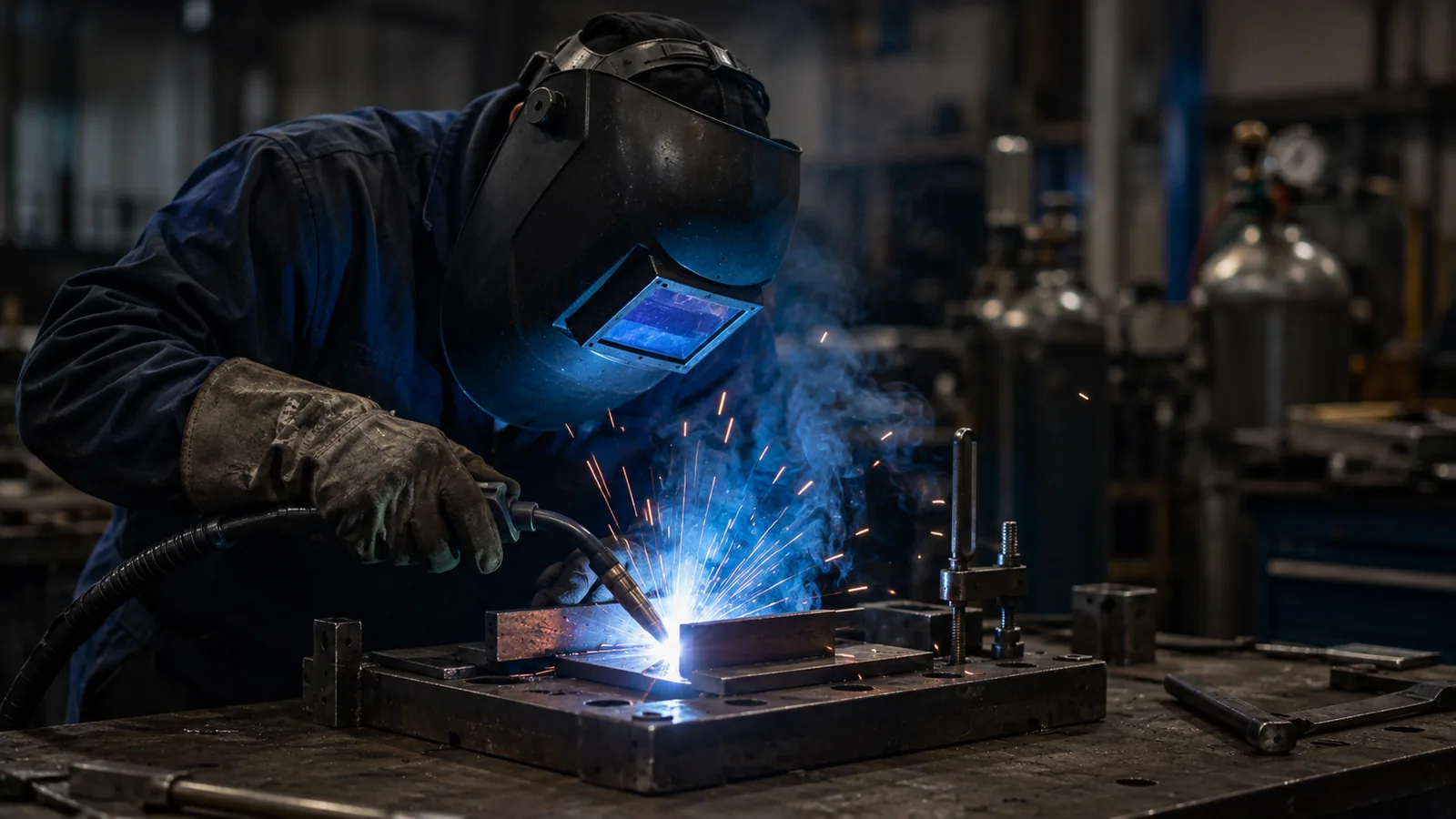
In a welding quality system, the WPS (Welding Procedure Specification) defines the parameters with which a given class of weld should be made, while the PQR (Procedure Qualification Record) is the evidence, obtained through testing, that the procedure works. In short, the PQR proves “this set of parameters can produce a sound weld,” and the WPS then guides actual production on that basis.
The key to compliance is proving that “every weld was made within a qualified WPS.” Traditional practice relies on manual spot checks and after-the-fact records, which can neither cover all welds nor self-prove each one at audit — whether the welder always followed the WPS often comes down to experience and trust.
A more reliable approach is to capture the current, voltage, gas flow and other parameters of each weld in real time and compare them automatically with the corresponding WPS, flagging anything out of range as non-conforming. WPS conformity thus shifts from “spot checks plus a paper declaration” to “weld-by-weld, real-time and evidenced.”
To genuinely achieve “weld-by-weld, real-time and evidenced,” the prerequisite is AI process recognition — because actual welding is often out of order, the system must first judge which procedure is being welded before it can retrieve the correct WPS to compare against. Further along this path, the WPS/PQR itself is evolving: an AI-fused next-generation welding procedure specification and procedure-quality assessment is gradually taking shape alongside the digital intelligence of welding — moving the procedure from a static document toward a dynamic capability that can be recognized, compared and assessed in real time.
It is also worth clearing up a common misconception: automated welding is not the same as digital intelligence. Robots and teach-free programming solve “getting the work done fast and steadily,” which is automation; digital intelligence points to fine-grained analysis and closed-loop control of the data from every weld — the two cannot substitute for each other. Take shielding gas: automated welding runs at a fast tempo and consumes more gas, and if supply is still set to a fixed value with frequent arc starts and stops, the absolute waste grows accordingly — in some cases the waste ratio can even exceed that of manual welding. Clearly, no amount of automation automatically brings insight into and control over the data. So, as welding becomes electrified, digitized, automated and intelligent, the real next step is to use AI to turn data into quantifiable, visible value — so that compliance and quality are continuously measured and safeguarded during the welding process.
This both lowers quality risk and provides an on-demand data foundation for the process-conformity proof required by standards such as ISO 3834 and EN 1090.
Suxin has long focused on smart welding, with 70+ invention patents in welding process recognition and process AI, and current and gas measurement precision calibrated by a third-party metrology institute. If you want the WPS conformity of every weld to be on record, you can book a quality-dashboard demo.